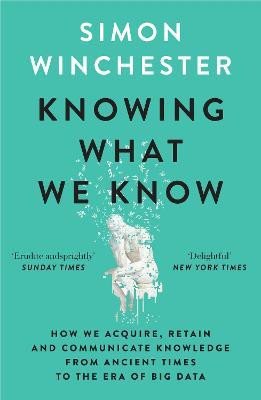
'A delightful compendium of the kind of facts you immediately want to share with anyone you encounter' New York Times 'An ebullient, irrepressible spirit invests this book.
| Vaše cena |
329,00 Kč |
| Vaše cena bez DPH |
329,00 Kč |
| |
| Dostupnost |
Skladem
2 ks
|
|
Odesíláme
ve středu
7.10.
|
Podrobný popis
'A delightful compendium of the kind of facts you immediately want to share with anyone you encounter' New York Times 'An ebullient, irrepressible spirit invests this book. It is erudite and sprightly'Sunday Times From the creation of the first encyclopedia to Wikipedia, from ancient museums to modern kindergarten classes-here is award-winning writer Simon Winchester's brilliant and all-encompassing look at how humans acquire, retain, and pass on information and data, and how technology continues to change our lives and our minds. With the advent of the internet, any topic we want to know about is instantly available with the touch of a smartphone button. With so much knowledge at our fingertips, what is there left for our brains to do? At a time when we seem to be stripping all value from the idea of knowing things - no need for maths, no need for map reading, no need for memorisation - are we risking our ability to think? As we empty our minds, will we one day be incapable of thoughtfulness? Addressing these questions, Simon Winchester explores how humans have attained, stored and disseminated knowledge. Examining such disciplines as education, journalism, encyclopedia creation, museum curation, photography and broadcasting, he looks at a whole range of knowledge diffusion - from the cuneiform writings of Babylon to the machine-made genius of artificial intelligence, by way of Gutenberg, Google and Wikipedia to the huge Victorian assemblage of the Mundaneum, the collection of everything ever known, currently stored in a damp basement in northern Belgium. Studded with strange and fascinating details, Knowing What We Know is a deep dive into learning and the human mind. Throughout this fascinating tour, Winchester forces us to ponder what rational humans are becoming. What good is all this knowledge if it leads to lack of thought? What is information without wisdom? Does Rene Descartes' 'Cogito, ergo sum'-'I think, therefore I am', the foundation for human knowledge widely accepted since the Enlightenment-still hold? And what will the world be like if no one in it is wise?
Bezpečnostní informace
Seznam varování o bezpečnosti knih vychází z požadavků nařízení (EU) 2023/988 o obecné bezpečnosti výrobků (GPSR):
1. Riziko poranění:
a) Zkontrolujte knihu z hlediska ostrých hran nebo sponek, které mohou způsobit poranění. b) Dávejte pozor na obaly z tvrdého papíru, které mohou mít ostré rohy. 2. Nebezpečí požáru:
a) Uchovávejte knihy mimo dosah zdrojů tepla a ohně. b) Vyhněte se ukládání knih na místech vystavených přímému slunečnímu záření, abyste zabránili vznícení. 3. Nebezpečí pro zdraví:
a) Dlouhodobé čtení může vést k únavě zraku, bolestem hlavy a problémům s koncentrací. b) Zajistěte při čtení dostatečné osvětlení, abyste snížili únavu zraku. c) Při čtení pravidelně dělejte přestávky, abyste si uvolnili oči a uvolnili svaly. 4. Nebezpečí pro duševní zdraví:
a) Knihy z některých kategorií mohou obsahovat kontroverzní nebo neslučitelný obsah. Před přečtením si přečtěte názory ostatních čtenářů. b) Intenzivní vstup do světa fantasy, sci-fi nebo hororu může vést k odtržení od reality a problémům s odlišením fikce od reálného světa. c) Obsah některých knih (násilí, krutost, drastické scény) může negativně ovlivnit emocionální zdraví, způsobit stres, úzkost a dokonce i depresi. 5. Nebezpečí pro děti:
a) Malé děti mohou vkládat knihy do úst, což může vést k udušení nebo spolknutí malých prvků. b) Dohlížejte na děti při čtení knih a ujistěte se, že je nevkládají do úst. c) Obsah obsažený v knihách může být vzhledem ke své problematice (násilí, erotika apod.) nevhodný pro děti a mládež. ). Vždy zkontrolujte věkové označení a přizpůsobte čtení věku a zralosti dítěte. 6. Udržování knih v dobrém stavu:
a) Uchovávejte knihy na suchém a čistém místě, abyste zabránili vzniku plísní a poškození způsobenému vlhkostí. b) Vyhněte se ukládání knih na místech vystavených extrémním teplotám a vlhkosti. c) Pravidelně čistěte knihy od prachu a nečistot, abyste zachovali jejich vzhled a trvanlivost. 7. Zdroje informací:
a) Ověřte si důvěryhodnost informací obsažených v knize, zejména pokud je používáte pro vzdělávací nebo profesní účely. b) Věnujte pozornost datu vydání, protože znalosti v některých oblastech se rychle deaktualizují. c) Při používání odkazů nebo internetových zdrojů uvedených v knize buďte opatrní a dodržujte pravidla bezpečnosti na síti. 8. Autorská práva:
a) Dodržujte autorská práva obsahu zpřístupněného v knize.