| Vaše cena | 409,00 Kč |
| Vaše cena bez DPH | 409,00 Kč |
| Dostupnost | Skladem 2 ks |
| Odesíláme v úterý | |
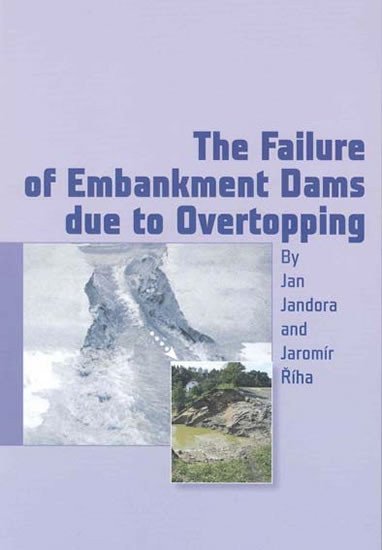
The existence of the dams retaining water either permanently or occasionally, is always connected with the risk of their failure. The failure of a dam gives rise to a flood wave that advances in the area behind the dam or through the valley below the dam. The effects of a dam break wave originated in this way may be disastrous and may cause numerous fatalities as well as financial losses exceeding many times the price of the hydraulic structure itself. In context with catastrophic floods, namely those in July 1997 and August 2002, and also with local flood events which occur almost every year, the dam safety problem became topical also in the Czech Republic, where more than 100 small dams and levees failed and about 10 large dams were seriously endangered due to overtopping. Contents The monograph aims to cover both theoretical and practical issues dealing with embankment dam breaching due to overtopping. It starts with the definition of the problem and related terminology. The third chapter provides the comprehensive database of dam failures all over the world and the statistical analysis of data dealing with dam construction and dam failures. In the fourth chapter, the dam breach mechanism during dam crest overtopping is described and analysed for various types of earth dam body. The description is demonstrated using experimental dam breach modelling results obtained by the authors of this monograph and other documents from abroad. The theoretical background of the dam erosion initiation and propagation is mentioned as well together with the comparison of calculated and observed sediment transport rate. The fifth chapter describes several approaches to the deterministic modelling of the dam breaching due to overtopping. The classification of various methods is performed and more detailed discussion is focused on one dimensional modelling. For the first estimate of dam breach parameters (maximum breach discharge, time of failure, shape and size of the breach) the empirical formulas derived from real dam failures are mentioned and discussed. Further on, the mathematical model of the dam failure is derived. For the solution, analytical and numerical procedures are used. Short description of computer codes is attached as well. Finally, sensitivity analysis of dam breach parameters is carried out using numerical finite difference method and the computer code NATRZ. Latin Hypercube Sampling method was used for the estimate of the probable worst possible, but realistic flood hydrograph. The principle of the solution is mentioned in the sixth chapter. One of the methods for mathematical models calibration is experimental earth dam breach research. Such a research was carried out in the laboratory of the Water Structures Institute in Brno. The overview of the methods and case studies is mentioned at the beginning of the chapter seven together with the description of experiments performed during years 1997 – 2000 in the Institute of Water Structures, Faculty of Civil Engineering, Brno University of Technology. The chapter eight provides reader the practical applications of previously described methods of dam breach mathematical modelling. Firstly, results of calculations are compared with results of experimental modelling, further on, several dams and one river levee were analysed from the view of their breaching due to overtopping and piping. The conclusions focus on the practical recommendations dealing with the increase of earth dam resistance against breaching in case of their overtopping. Finally, the necessary steps of the assessment of potential earth dam breaching and its modelling are mentioned.